
Know Where a Word Comes From, and It Stays
Add one precise phrase that explains a sentence, and recall rises from 42% to 74%. WordLinea tells each word where it comes from: take coherent apart and it is “sticking together”, which is why it means “logical and consistent”.
In this note· 2 sections
Things with a cause are easy to remember. “The tall man bought the crackers” is gone a minute later: who bought the crackers? “The tall man bought the crackers on the top shelf” stays, because you need to be tall to reach the top shelf.
Words work the same way. coherent means “logical and consistent”; learned by rote, it is a string of letters. Take it apart: co- (together) + haer- (stick). Parts sticking together hold together, and the word stays. Each section below covers one design.
A Precise Reason Is Remembered
In 1979, Stein and Bransford gave college students 10 sentences like “The tall man purchased the crackers.” One group read the sentences as they were; one read them with an unrelated phrase added, “that were on sale”; one with a phrase that explained them, “that were on the top shelf”; and one group added a phrase of their own. Then they filled in the blank: “The ___ man purchased the crackers.”[1]
The phrase that explained the sentence tied “tall” to “reaching the top shelf”, and recall rose from 42% to 74%. The unrelated phrase had nothing to do with being tall, and recall fell to 22%.
A story ties things together the same way. Bower and Clark asked students to learn 12 lists of 10 nouns each. Half of them made up a story for each list; the other half studied for the same time as usual. Tested after all 12 lists, the storytellers recalled 93% of the words; the others, 13%.[2]
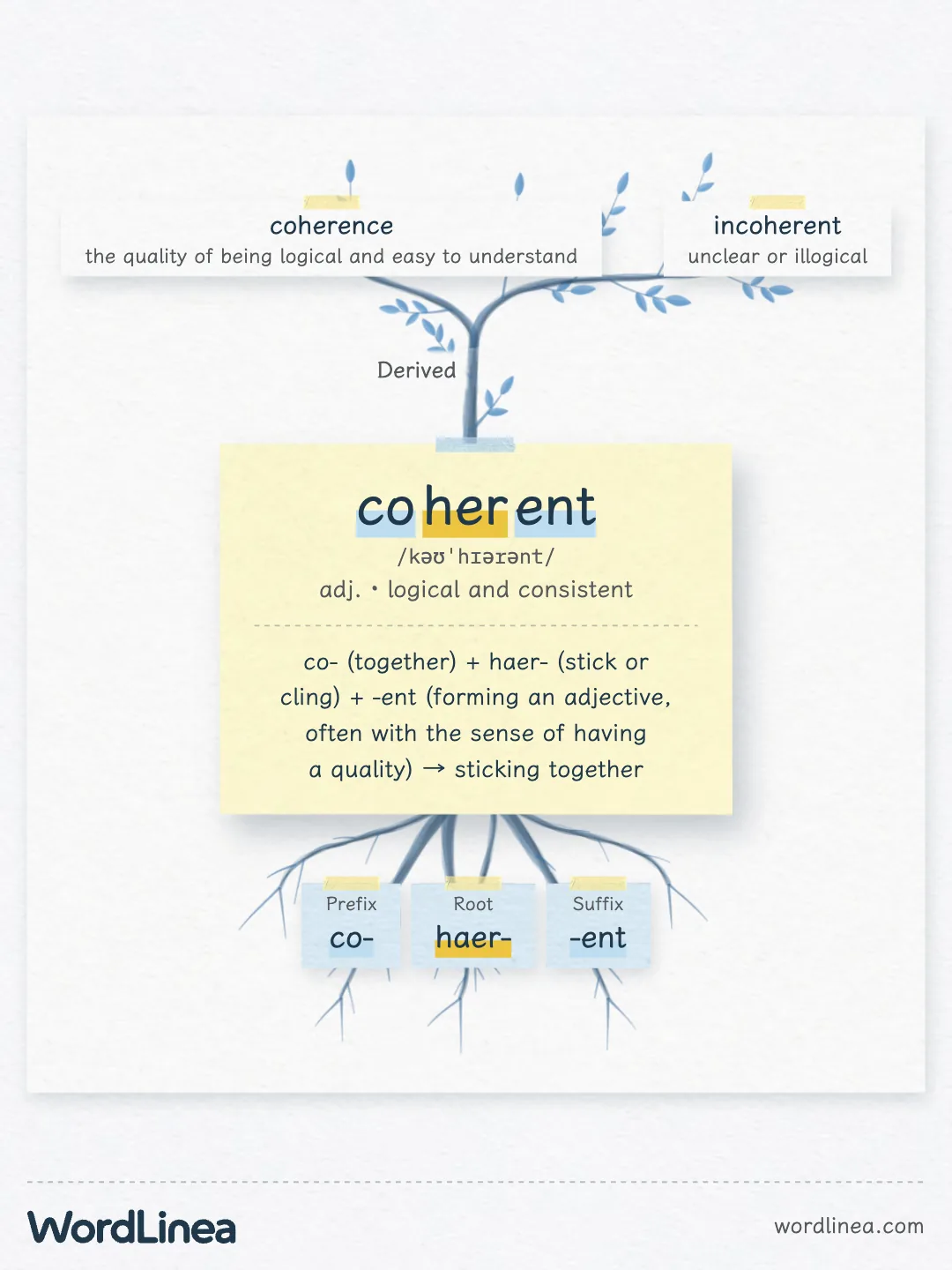
WordLinea’s approachSave a word and its page has a word tree: the card in the middle shows the parts the word is made of, what each part means and what they add up to; the words derived from it grow above. Open a root below to grow the other words built on it.
The Answer Shows Where the Word Comes From
Many people learn a word by saying “coherent, logical and consistent” over and over. Repeating the meaning leaves nothing to link the word to what it means.
Tresselt and Mayzner showed people 100 words: one group copied each word, one crossed out its vowels, and one judged how related each word was to “economic”. Asked to write down the words they remembered, the group that judged meanings recalled twice as many as the copiers and four times as many as the vowel group.[3]
Remembering a word also takes recalling it now and then, as No. 1, Memory Is Made in Recall, explained. The word tree gives each recall an origin to follow back.
References
- [1]Stein, B. S., & Bransford, J. D. (1979). Constraints on effective elaboration: Effects of precision and subject generation. Journal of Verbal Learning and Verbal Behavior, 18(6), 769–777. doi:10.1016/S0022-5371(79)90481-XExperiment
- [2]Bower, G. H., & Clark, M. C. (1969). Narrative stories as mediators for serial learning. Psychonomic Science, 14(4), 181–182. doi:10.3758/BF03332778Experiment
- [3]Tresselt, M. E., & Mayzner, M. S. (1960). A study of incidental learning. The Journal of Psychology, 50(2), 339–347. doi:10.1080/00223980.1960.9916451Experiment